Introduction
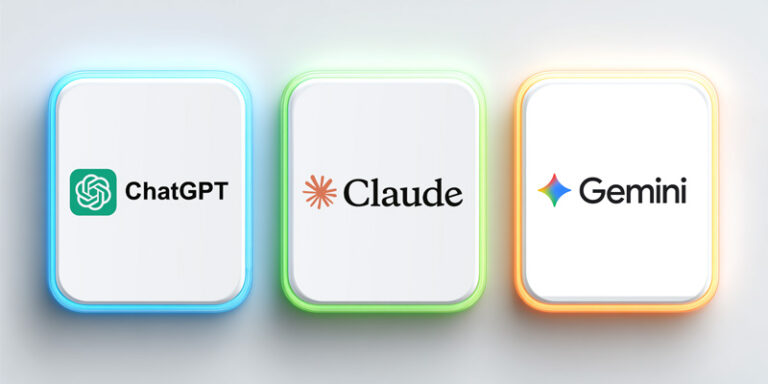
Not all AI models think—or answer—the same way. In 2025, three players dominate the professional AI conversation space: ChatGPT (by OpenAI), Claude (by Anthropic), and Gemini (by Google DeepMind). They share broad similarities—large language models trained on vast data—but their design philosophies and output styles differ. The same question asked across these tools can produce strikingly different answers. For business professionals, knowing these differences can save hours and help choose the right tool for the right job.
Why Compare These Models?
Each of these models is widely available and backed by major companies. They integrate into productivity ecosystems (Microsoft, Google, or custom APIs), and they’re tuned differently in tone, safety, and reasoning. If your work involves drafting reports, analyzing data, or exploring creative content, understanding the nuances can give you a competitive edge. Let’s break it down.
Test Setup: One Question, Three Models
To illustrate differences, let’s imagine we ask all three models the same prompt: “Summarize the latest trend in renewable energy and suggest one business opportunity.”
ChatGPT (OpenAI)
- Style: Clear, structured, and professional. Uses bullet points or numbered lists when appropriate.
- Response Example: Identifies solar panel adoption, cites potential government policy, and suggests an opportunity in battery storage for small businesses.
- Strengths: Balanced, well-organized, and confident. Excellent for presentations, drafting polished content, or structured workflows.
- Limitations: Sometimes too confident—presents uncertain info as fact. Requires verification when accuracy is critical.
Learn more: ChatGPT • GPT-5 • o3 & o4 Mini
Claude (Anthropic)
- Style: Conversational, cautious, and reflective. Offers nuance and ethical framing.
- Response Example: Notes growth in offshore wind, highlights social impact, and suggests community-based renewable microgrids.
- Strengths: Great for long documents, policy analysis, or thoughtful strategy work. Handles ethical or sensitive contexts with care.
- Limitations: Can hedge too much, adding extra words where brevity is preferred. Less concise than ChatGPT in some business use cases.
Recent update: Claude 3.5 Sonnet supports very large contexts (up to 200K tokens) which helps on long documents. Claude 3.5 Sonnet • AWS Bedrock
Gemini (Google DeepMind)
- Style: Fast, data-driven, and highly integrated with Google’s ecosystem.
- Response Example: Pulls in recent renewable energy news, references data points, and suggests an SEO-friendly angle for businesses in green tech marketing.
- Strengths: Tight linkage to Google Search & Workspace surfaces fresh trends and supports multimodal inputs/outputs (text, images, audio).
- Limitations: Still evolving—output can feel fragmented. Sometimes overly focused on keywords rather than holistic insights.
Learn more: Gemini AI Update • Gemini 2.0 • Google Workspace AI
Mini Case Study: A Marketing Team at Work
Imagine a startup’s marketing team planning content for a clean energy campaign:
- The strategist runs the brief through Claude to surface ethical concerns and long-term positioning.
- The content writer drafts the blog outline in ChatGPT, benefiting from its structured outputs.
- The SEO lead queries Gemini for up-to-date keyword clusters and recent search trends.
By combining all three, the team covers thoughtful strategy, polished writing, and fresh data in a single workflow.
Practical Tips for Choosing the Right Model
- Need polished prose fast? Go with ChatGPT.
- Working on sensitive, complex issues? Claude offers more nuance and caution.
- Chasing trends or SEO insights? Gemini connects well to live web data and Google’s suite.
For power users, don’t think “either/or.” Instead, treat these tools as complementary—like having three consultants with different personalities.
Beyond 2025: The Convergence Question
Some analysts expect these models to borrow features from one another as competition accelerates. For now, though, their differences remain important. If your team depends on real-time web context—such as current events or live trend data—you should select models that explicitly support this capability. At the moment, Gemini 2.0 provides native multimodal output (including images and text-to-speech) in some scenarios, which is particularly useful for content and marketing workflows.
Conclusion
Asking the same question across ChatGPT, Claude, and Gemini won’t give you the same answer—and that’s the point. Each model reflects a unique philosophy and set of strengths. Instead of betting on a single winner, consider how to blend them into your workflow. The professionals who thrive in 2025 will be the ones who treat AI as a toolkit, not a monolith. If you want more breakdowns like this—side-by-side comparisons and workflow guides—subscribe to NextMindGen for upcoming posts.