Introduction
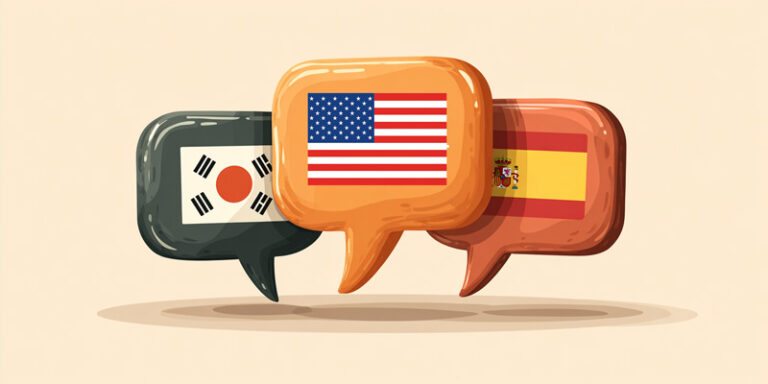
Change the language, change the output. Ask the same AI for the same task in English, Korean, and Spanish, and you often get different tone, structure, and detail. Sometimes it is a pleasant surprise: a crisper summary or a warmer voice. Other times it introduces errors or cultural mismatches. In this post, we run controlled tests across three languages and distill practical rules for getting consistent results in a multilingual workflow.
Setup: One Task, Three Languages
Task: Generate a 120-word product description for a smart desk lamp with auto-dimming and a focus timer.
Controls: Same constraints across languages: audience = home office workers, tone = friendly and practical, avoid jargon, include one benefit and one spec.
Evaluation: We judge clarity, cultural fit, and instruction adherence. When needed, we ask the model to show its source language reasoning then translate to the target language to reduce loss.
Trial 1: English
Prompt: “Write a 120-word product description for a smart desk lamp with auto-dimming and a 25-minute focus timer. Audience: home office workers. Tone: friendly and practical. Avoid jargon. Include one clear benefit and one concrete spec.”
Observation: Output is well structured with a clear callout of the spec. Typical strength: headline style sentences and consumer-friendly phrasing. Typical risk: generic benefits that need one specific scenario.
Fix: Ask for one real-life scene: morning email session or late-night reading. This anchors the copy in a relatable moment.
Trial 2: Korean
Prompt (Korean): “오토 디밍과 25분 집중 타이머가 있는 스마트 스탠드 조명을 120자 내외로 소개해 주세요. 대상: 재택근무자. 톤: 친근하고 실용적. 전문 용어는 피하고, 한 가지 이점과 한 가지 구체 스펙을 포함하세요.”
Observation: 공손체와 광고체가 섞일 수 있다. 수치 표기나 시간 단위에서 한영 혼용이 발생하기도 한다.
Fix: 존댓말 일관성 지시와 단위 표기 규칙을 명시: “숫자는 아라비아 숫자, 시간은 분 단위, 종결형은 ‘-습니다’로 통일.”
Trial 3: Spanish
Prompt (Spanish): “Escribe una descripción de 120 palabras para una lámpara de escritorio inteligente con atenuación automática y un temporizador de enfoque de 25 minutos. Público: trabajadores en casa. Tono: cercano y práctico. Evita la jerga. Incluye un beneficio claro y una especificación concreta.”
Observation: El tono suele ser cálido y directo, pero a veces usa adjetivos genéricos. Riesgo común: frases largas sin pausa que pierden impacto.
Fix: Pedir una frase de apertura corta y una lista breve con una ventaja y una especificación. Esto mejora la legibilidad y mantiene el enfoque.
Side-by-Side Outputs: What Changed
- Tone: English favors punchy benefits. Korean leans polite and informative. Spanish often reads warmer and more emotive.
- Structure: English defaults to paragraph plus callout. Korean may compress details into fewer sentences. Spanish benefits from one short intro line followed by a concise detail line.
- Specificity: All three improve when given one concrete scene and a strict spec line: lumen range, timer length, or energy savings.
Takeaway: Language choice nudges defaults. Counteract this by making the non-negotiables explicit: audience, tone, length, scene, and one data point.
Common Failure Modes and Fixes
1. Mixed Formality
Symptom: Korean output flips between casual and formal. Spanish swings between neutral and overly enthusiastic.
Fix: Specify formality: “존댓말 유지” or “tono profesional cercano.” Add an example sentence to anchor style.
2. Lost Numbers in Translation
Symptom: Units or counts vanish or change.
Fix: Freeze numbers with brackets: “[25-minute timer], [800 lumens].” Ask the model to confirm numbers at the end.
3. Over-Translation of Brand Terms
Symptom: Product or feature names get translated awkwardly.
Fix: Mark no-translate terms: “NO-TRANSLATE: Focus Timer, Auto Dimming.” Provide a glossary at the top.
Reusable Multilingual Prompt Template
Task: [what you want] Audience: [who] Tone: [e.g., friendly and practical] Language: [English | 한국어 | Español] Length: [characters or words] Non-Negotiables: [one scene], [one data point], [units] No-Translate Terms: [brand | feature] Output: [paragraph | bullets] Quality Check: confirm numbers and keep formality consistent Mini Case Study: Support Email Across Three Languages
Context: A hardware startup needed the same warranty response email in English, Korean, and Spanish.
Problem: The English version was crisp, but the Korean version mixed styles and the Spanish version ran long.
Solution: Added a formality rule, a 90-word cap, one scenario, and a no-translate glossary. Asked for a final checklist: confirm numbers and dates.
Outcome: Three consistent emails that felt native, not machine translated.
Why Language Influences Output
Models learn from large text corpora that encode stylistic norms. That means different defaults by language: sentence length, politeness markers, and idioms. You can nudge these defaults by providing explicit constraints and style examples. When quality matters, generate in the target language directly instead of translating from English, or ask for reasoning in the source language then a final translation to the target language to reduce drift (Source: Research overviews on multilingual LLM behavior).
Conclusion
Multilingual prompting is not just translation. It is design: choose tone, formality, and structure intentionally for each audience. Start with one shared template, then tune by language using scenes, numbers, and no-translate glossaries. With a little upfront structure, your English, Korean, and Spanish outputs can feel equally natural.
Next step: Duplicate the template above and run your own three-language test. For a ready-made pack of cards, download the free Multilingual Prompt Kit and adapt it to your brand.